Team Meat's transition from the 2D realm of gaming to a fully realized 3D experience in Super Meat Boy 3D is drawing both anticipation and skepticism. This evolution, occurring on March 31, 2026, merges the frenetic, precision-focused gameplay that defined the original 2010 platformer, Super Meat Boy, with a three-dimensional space. However, deciphering whether this leap lands with both feet firmly planted or stumbles into missteps remains a nuanced discussion.
The ambition to migrate from 2D to 3D is fraught with challenges, highlighted dramatically by industry giants like Mario and Sonic. Nintendo's iconic character navigated the transition with ease, reinventing platforming in three dimensions. Meanwhile, Sonic's attempts seem to have faltered, struggling to maintain that tight control and seamless experience. Team Meat stands at this crossroads, striving to capture the essence of Super Meat Boy while embracing the complexities a 3D format introduces.
Gameplay Mechanics and Control
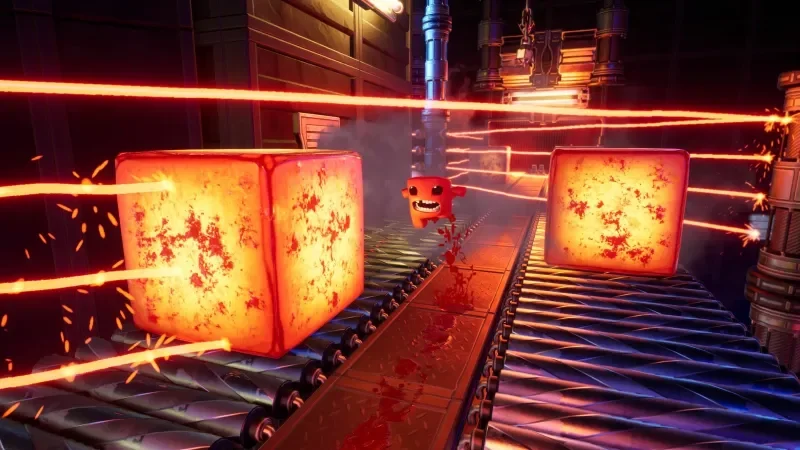
At the heart of Super Meat Boy 3D lies the familiar tight control system, which appears to have made a successful transition, preserving the high-octane platforming experiences fans cherish. Players control Meat Boy through a series of linear levels that incorporate isometric and sidescrolling perspectives. This blend seeks to marry the nostalgic feel of the original with the new dimension's depth.
The levels, praised for their clever design, provide opportunities for quick completion and reward players with a satisfying rush upon successful runs. The blend of skill and speed remains intact, as evidenced by the instant respawn feature that echoes the series' legacy. Post-level replays showcasing failed runs—featuring clones of Meat Boy—add an interesting dynamic to the experience, making victories visually exhilarating.
Critical Challenges in 3D Movement
That said, navigating through the 3D environment isn’t without its complications. The significant concern arises with depth perception, something many games manage with intuitive mechanics. In Super Meat Boy 3D, players often find themselves questioning their positioning with jumps that feel ambiguous at best. Fixed camera angles can obscure the player’s perspective, making it challenging to gauge jumps accurately. This design choice leaves a lingering frustration that can overshadow the thrill of the chase. Moreover, the pacing demands instantaneous reactions, making any moment of hesitation perilous.
A red landing ring below Meat Boy serves to assist players, yet this feature does little for forward momentum—an inherent challenge that arises within fast-paced environments. The instinct might be to criticize the difficulty; however, the frustration can sometimes detract from the core enjoyment of the game, raising questions about whether the transition fulfills its potential.
Visual and Auditory Design Considerations
Visually, Super Meat Boy 3D captures much of the stylistic flair that characterized its predecessor. Yet, while lively environment and character designs thrive, the music proves to be a weak point. The soundtrack—lacking in energy and uniqueness—fails to resonate with the zany, bloody antics of Meat Boy's world, posing a missed opportunity for creating a fully immersive experience.
Conclusion: Navigating the Balancing Act
While Super Meat Boy 3D showcases Team Meat's commitment to reinvigorating its renowned formula within a 3D context, the execution of these ideas is still a work in progress. The transitional struggles between dimensions reflect broader challenges within the gaming industry—an ongoing scrutiny that both challenges developers and invigorates the conversation among gaming enthusiasts. For those invested in platformers, observing how Team Meat addresses these kinks will be crucial. Can they refine the controls and correct the depth perception issues in time for the game's release? For players who adored the original, the hope is palpable—yet the journey toward realization is just beginning.
In the end, if you’re eager to dive into this new iteration, remain prepared for a rollercoaster ride of nail-biting challenges and moments of sheer frustration. Just as iconic as the jumping plumber or the blue hedgehog, how Meat Boy navigates the new 3D landscape may well define not just its legacy but set the tone for future transitions within the platforming genre.